The man who invented the first female scholar


Whenever a new academic year comes around, that old brew of excitement and nerves begins to creep up on me. I catch myself quietly conjuring up timetables, freshly printed syllabuses, late evenings in the library, coffee-stained notebooks. I find myself secretly, and perhaps rather preposterously, longing for the pains and pleasures of learning.
And yet, here I am, with my checklist of academic milestones complete: lectures attended, countless hours spent in the library, great books read, discussed and written about, exams duly sat, degree received. Still, I find myself wondering: was I simply one of the fortunate ones? What became of the women who came before me? Who were the first women to take their seats in university lecture halls, endure the presumably disapproving stares of their male counterparts and, despite it all, persevere?
So I made it my goal to find out more about these women. I was about to sketch out a piece on the life of the woman first credited with receiving a doctorate in the fifteenth century, and on the historical divide between northern and southern European universities – a subject I found fascinating in its own right – when I stumbled upon something quite unexpected: a most intriguing ‘feminist forgery’, concocted by an eighteenth-century Italian lawyer and historian in the name of the first female scholar.
The search for the first woman scholar
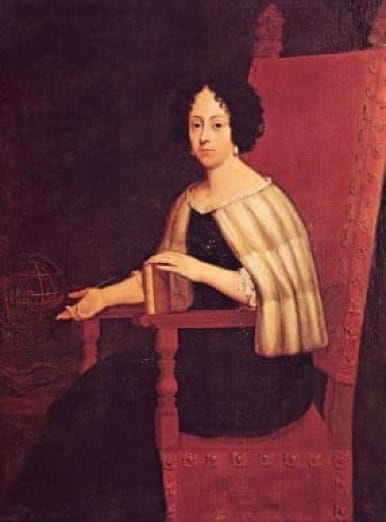
As I tried to establish who had been the first woman to receive a university degree in Europe, one name kept surfacing: Elena Cornaro Piscopia. In 1678, she was awarded a doctorate by the University of Padua, becoming the first woman in Europe to receive one. The evidence was there. University records attested to her academic distinction; she was admitted to several prestigious academies, and her scholarly work found its way into print. The university archives leave no doubt as to her existence and remarkable academic achievements.
I was quite happy to take the Cornaro case as my starting point, treating her as a representative of the first woman to attain such a remarkable academic distinction. But another search brought a different contender into view. Bettisia Gozzadini, a thirteenth-century Italian jurist, was allegedly not only the first woman to earn a doctorate but also the first to hold a university professorship. This was enough to make me pause. Who was she and where had this story come from? So I followed the trail back to the eighteenth century, where I stumbled upon an Italian lawyer and historian named Alessandro Machiavelli, who had made it his mission to defend women's right to a university degree.
A degree denied
Gozzadini's reputation as the first female scholar emerged in rather unexpected circumstances. On 2 July 1722, Maria Vittoria Delfini Dosi, the teenage daughter of a Bolognese nobleman, defended her legal theses at the Spanish College in Bologna, only to be denied a university degree in law.
The historian Paula Findlen, one of the few scholars to have explored the case, points out that Dosi's father had a vested interest in securing the degree for his daughter. As was often the case among wealthy families at the time, an educated daughter could be a valuable social asset, opening doors to influential circles and helping the family climb the social ladder, so to speak.
Yet the elaborate ceremony her father had so carefully arranged did not quite produce the celebration he had anticipated. Rather than grant Dosi her degree, the examiners turned to the university archives, searching for historical precedents that might justify admitting a woman to the ranks of its graduates. They weren't necessarily questioning whether women deserved a place in higher education. Rather, they wanted to know whether the university's own history could provide a reason to grant Dosi an exception. And if no precedent could be found, why should they start now?
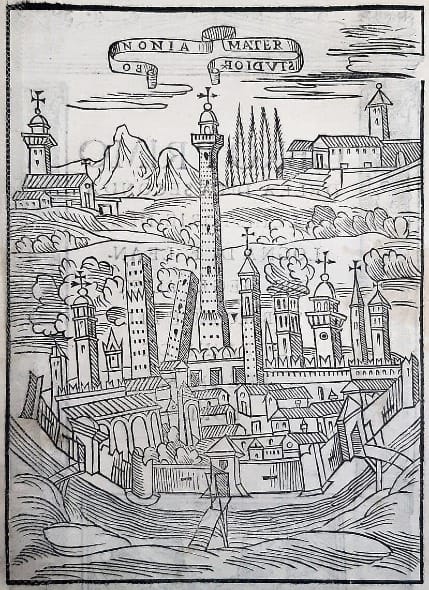
Delfini Dosi's case had sparked a heated debate in the city of Bologna. The question of whether a woman should receive a university degree stirred considerable discussion in academic circles. Bologna had a reputation for being home to a number of learned women, whose achievements formed part of the city's intellectual heritage. Historian Jane Stevenson makes an interesting observation in Women Latin Poets: Language, Gender, and Authority, from Antiquity to the Eighteenth Century. She notes that
‘by the 16th century, for a city to harbour a handful of women poets and scholars was perceived by literati as an index of civilization, a view which can be seen establishing itself during the previous century’ (Stevenson, 142).
In Bologna, then, the presence of learned women was not simply a matter of individual achievement; it had become part of how the city understood and presented itself.
Inventing a medieval precedent
A young lawyer, probably still a university student at the time of Dosi's unsuccessful bid for a degree, Alessandro Machiavelli decided to take matters into his own hands. To understand what happened next, it helps to know a little about Machiavelli and his fascination with medieval history. Findlen offers a rather telling description of his obsession with the period: ‘Machiavelli sought to inhabit the Middle Ages with every fibre of his very being, treating it as a living legacy to cultivate and bring forth.’ In other words, he was quite obsessed with the Middle Ages – and clearly wanted to make a name for himself.
Upon encountering the controversy surrounding Delfini Dosi's case, Machiavelli set about filling what he perceived as a gap in the historical record. Under his brother's name, he published a treatise presenting an account of medieval women scholars at the University of Bologna. Among them was Bettisia Gozzadini, whom he claimed had been the first woman to graduate from the university and later become a professor. In doing so, he gave Bologna something rather valuable: a historical precedent for women belonging in the academic world.

According to Machiavelli's account of Gozzadini's life, she was born in Bologna in 1209. She was a brilliant mind who received her doctorate in law in 1236 and, three years later, was appointed professor at the University of Bologna. Students flocked to her lectures, and she was even asked to deliver the eulogy at the funeral of the city's archbishop, Enrico della Fratta, in March 1241. The ancient medal that Machiavelli had allegedly discovered depicted her as a modest woman, humbly dressed, presumably conforming to the image of a woman who did not wish to stand out.
Earlier accounts, however, paint a rather different picture. As Findlen explains, she bore little resemblance to the figure depicted in Machiavelli's account. Instead, these earlier descriptions portrayed her as someone who had rejected traditionally feminine pursuits and, from the age of twelve, dressed as a man and proclaimed herself a follower of Plato. Something didn't quite add up.
The making of a historical figure
But the examiners weren't convinced. They demanded hard evidence that Gozzadini had indeed graduated. Such proof was difficult, if not impossible, to come by because, as Findlen explains, the University of Bologna did not begin keeping records of its professors until 1384, and records of degrees were not introduced until the fifteenth century, with the earliest surviving documentation dating from 1480. Nor were there any surviving chronicles in Bologna from before the fourteenth century.
But if the evidence couldn't be found in the university archives, where was it? According to Machiavelli, it had survived in something less tangible: cultural memory. As he argued in his treatise, the evidence rested on the ‘authority of centuries, traditional wisdom, and common opinion’ (Findlen, 884). One thing worth bearing in mind here, as Findlen also reminds us, is that the Middle Ages was something of a terra incognita at the time. There were considerable gaps in the historical record, which were often filled by cultural memory. Machiavelli, in other words, trusted what people had remembered and passed down over the centuries more than what the university had actually written down. Still, the chances of winning this battle were slim.
Machiavelli understood that, if he wanted to convince the examiners, he would have to present some serious evidence. So he began piecing together Gozzadini's academic career, leaving references to her wherever he could. His most spectacular forgery was the ‘discovery’ of an ancient calendar of the University of Bologna. As Findlen reveals, ‘he invented his most spectacular discovery: an ancient calendar of the medieval Studium which decisively confirmed Bologna's tradition of women graduates and professors’ (885). His work on the history of Bologna's coinage was just as questionable: it was full of coins that had never actually existed. His credibility as a historian was beginning to crumble.
Machiavelli may have been fond of embellishing history, but he was certainly not short of wit or historical knowledge. In the years that followed, he went to great lengths to make sure Gozzadini appeared in other historical documents, too. He knew that ‘creating a fact was not sufficient to make it stick’, Findlen points out.
‘He continued to cite the sources out of which her life had been fabricated for the rest of his career, furnishing the strongest proofs from the arsenal of spurious documentation he invented.’ (Findlen, 893-94)
In a way, he was giving his own invention a life of its own, repeating it often enough for it to become part of the historical record.
A feminist forgery?
In the absence of university records, and given his reputation as an incurable forger, it is widely accepted that Alessandro Machiavelli invented the first female scholar. This is not to say that Bettisia Gozzadini never existed. She most certainly lived and breathed in medieval Bologna, but Machiavelli gave her a different life.
What puzzles me still is why he did so. From what I have managed to read, I have come to think that it all boiled down to his ambition. Many have labelled him ‘the feminist forger’. There were certainly other cases of women being reinvented in early modern Italy. We cannot take these stories as historical fact, and we may never know exactly why these women were reinvented. But I think there is a kernel of truth to be found in these fabrications: learned women were seen as a sign of civilization, and some men took it upon themselves to celebrate and preserve that legacy, even if they went about it in entirely the wrong way.
Perhaps there was something of early modern feminism in it. Or perhaps Machiavelli was simply trying to make a name for himself. Either way, I will leave you with Professor Stevenson's words:
They [inventors of women scholars] were therefore very useful, since they gave two or three hundred years’ worth of precedent to level against doubters who treated women’s education as a dangerous innovation.’ (152)
And so the question remains: why did the committee look to the past to justify the present? Would it really have mattered if Bettisia Gozzadini, the academic, had been a real historical figure? Would Dosi have received her doctorate in 1722?
Perhaps, in the end, the most interesting thing about this story is not the woman Machiavelli invented, but the world that made her invention seem necessary.
Works Cited
Findlen, Paula. ‘Inventing the Middle Ages: An Early Modern Forger Hiding in Plain Sight’. In For the Sake of Learning: Essays in Honor of Anthony Grafton, edited by Ann Blair and Anja-Silvia Goeing, vol. 2, pp. 871–896. Leiden: Brill, 2016.
Machiavelli, Carlo Antonio [attributed; written by Alessandro Machiavelli]. Bitisia Gozzadina seu de mulierum doctoratu apologetica legalis-historica dissertatio. Bologna, 1722.
Stevenson, Jane. Women Latin Poets: Language, Gender, and Authority from Antiquity to the Eighteenth Century. Oxford: Oxford University Press, 2005.