Halloween and the ghosts of its prehistory


It is almost time to dust this skeleton costume, load the candy baskets and carve this massive pumpkin into an evil-looking vegetable. Halloween is approaching and you don’t need an American passport to indulge in the day’s festivities anymore. October 31 has spread its wings back to its origins and beyond. Even though I’ve always been thrilled by the chilling atmosphere and totally captivated by the spooky aesthetic, questions are still ringing in my head: what is it exactly that we are partying for? Why do kids go trick-or-treating? What is it that we celebrate? I decided to do a bit of digging into the very beginnings in order to satisfy my curiosity.
Exploring the origins of Halloween proved a more complicated endeavour than I had imagined. Research is not extensive and the journey to modern Halloween is nothing but linear. I gathered my material from two sources: Lisa Morton’s ‘Trick or Treat, A History of Halloween’ and Ronald Hutton ‘Stations of the Sun’. What follows is a summary and a personal interpretation of the arguments found in these books.
Samhain
Popular belief credits the Celts with the origins of modern Halloween. Samhain, a Celtic festival celebrated on November 1, is at the root of the celebration. Many believe Samhain marked the beginning of the Celtic new year. It is also said that it was a time when the gates between this world and the ‘otherworld’— the realm of the spirits — were wide open. It was when the Celts called on their ancestors for guidance in order to understand the cycles of life and death that the end of summer and the beginning of winter brought along.
Historian Ronald Hutton, however, in his ‘Stations of the Sun’ debunks the myth of Samhain as the beginning of the Celtic New Year and argues that there is no sufficient evidence that suggests a connection with the dead. Hutton claims that Samhain was indeed a festival that ‘marked the opening of winter in early medieval Ireland’. Harvest was completed and so were warfare and trade. This made it an excellent moment for the ‘convention of the year’s most important tribal assemblies’, Hutton argues. It is said that it lasted three days before and three days after Samhain and, according to translator Jeffrey Gantz, ‘during these seven days there would be nothing but meetings and games and amusements and entertainments and eating and feasting.’

Gantz also reports that it ‘was regarded as a time of unusual supernatural power because of a number of stories set at the feast in which humans are attacked or approached by deities, fairies or monsters’. Hutton attributes this to the nature of the feast: ‘it was a major gathering of royalty with time on their hands’. Perhaps a less romanticised version of Samhain, but no less compelling.
It wouldn’t seem unfitting for Samhain to be given the status of the new year, and so believed academics during the 19th century. However, more recent research suggests otherwise. Hutton opposes the popular conception of Samhain as the Celtic New Year, showing the flimsy nature of the evidence, as it does not come from early records but is inferred from contemporary folklore traditions. Another popular idea about the Celtic festival is that Samhain was the pagan Celtic feast of the dead. To understand the connection between the pagan end-of-summer feast and the remembrance of the dead, we need to look away from the Celts and into the emerging medieval Christian Church.
All Saints’ Day
An important turning point in the history of modern Halloween was the introduction of All Saints' Day on November 1 by the Catholic Church. Lisa Morton, in her “Trick or Treat, a History of Halloween,” explains how the Catholic Church, in their attempt to convert people from paganism to Christianity, did not destroy the existing pagan rituals but rather turned them to Christian purposes. In 609, the Pantheon in Rome was renamed the Santa Maria Rotunda and was turned to the service of the Virgin Mary and all the martyrs on May 13. According to Morton, May 13 was not a random date. It coincided with the final night of Lemuria, the Roman festival of the dead. ‘Some time in the mid-eighth century Pope Gregory III moved the feast of the martyrs to 1 November, the date of Samhain, and indicated that it was henceforth to be a celebration of ‘all the saints’’, Morton continues the historical narrative.
But why was the date moved? Morton briefly notes one possible explanation: ‘so that the harvest could be used to feed the hordes of pilgrims flocking to Rome for the saints’ celebration’, but quickly turns to another story. According to Morton and other 19th-century narratives, the date was altered by the Church in order to take over Samhain as the Christianized Celts were reluctant to abandon their end-of summer rituals. It was therefore considered a Christianization of a pre-existing festival.
This decision to move the date of the Catholic commemoration of the dead to the day the ancient pagan festival took place led to the conclusion that Samhain had been the Celtic feast of the dead. Ronald Hutton, however, is not convinced. He argues that the nature of the evidence is flimsy. There is no connection, Hutton claims, between the pagan day of the dead and Pope Gregory’s decision to move the day to 1 November. In fact, it was only in England and Germany where the martyrs used to be commemorated on November 1. Hutton adds that in Ireland the dead were remembered on April 20, ‘which disproves that the November date was chosen because of Celtic influence.’
I haven’t been able to find a clear-cut answer to the date-relocation controversy but, whatever the reason behind it, the fact remains that the pagan festival and the Christian feast of the dead were merging into what is yet to become the modern Halloween.
En route to modern Halloween
All Hallows’ Eve – the evening of 31 October – has crept into various communities in the British Isles as a time for feasting and socialising. In 19th-century Ireland, as Hutton describes, the Celtic and Catholic traditions were fully assimilated:
Most families prepared an unusually good communal meal for the evening, the poor going about in the day ‘collecting money, bread-cake, butter, cheese, eggs, etc., etc.’ from the wealthier homes, ‘repeating verses in honour of solemnity, demanding preparations for the festival in the name of St Columb Kill’. When all was ready, candles would be lit and prayers formally offered for the souls of the dead. After this, the eating, drinking, and games would begin.
Similar practices were observed in the Highlands of Scotland and Wales. In England and southern Scotland, however, ‘there is little trace of feasting and merry-making until the present century’. Hutton hypothesized that ‘the lack of an underlying ancient festival and the presence of a thorough religious reformation had created a vacuum at Hallowtide’.
The festivities
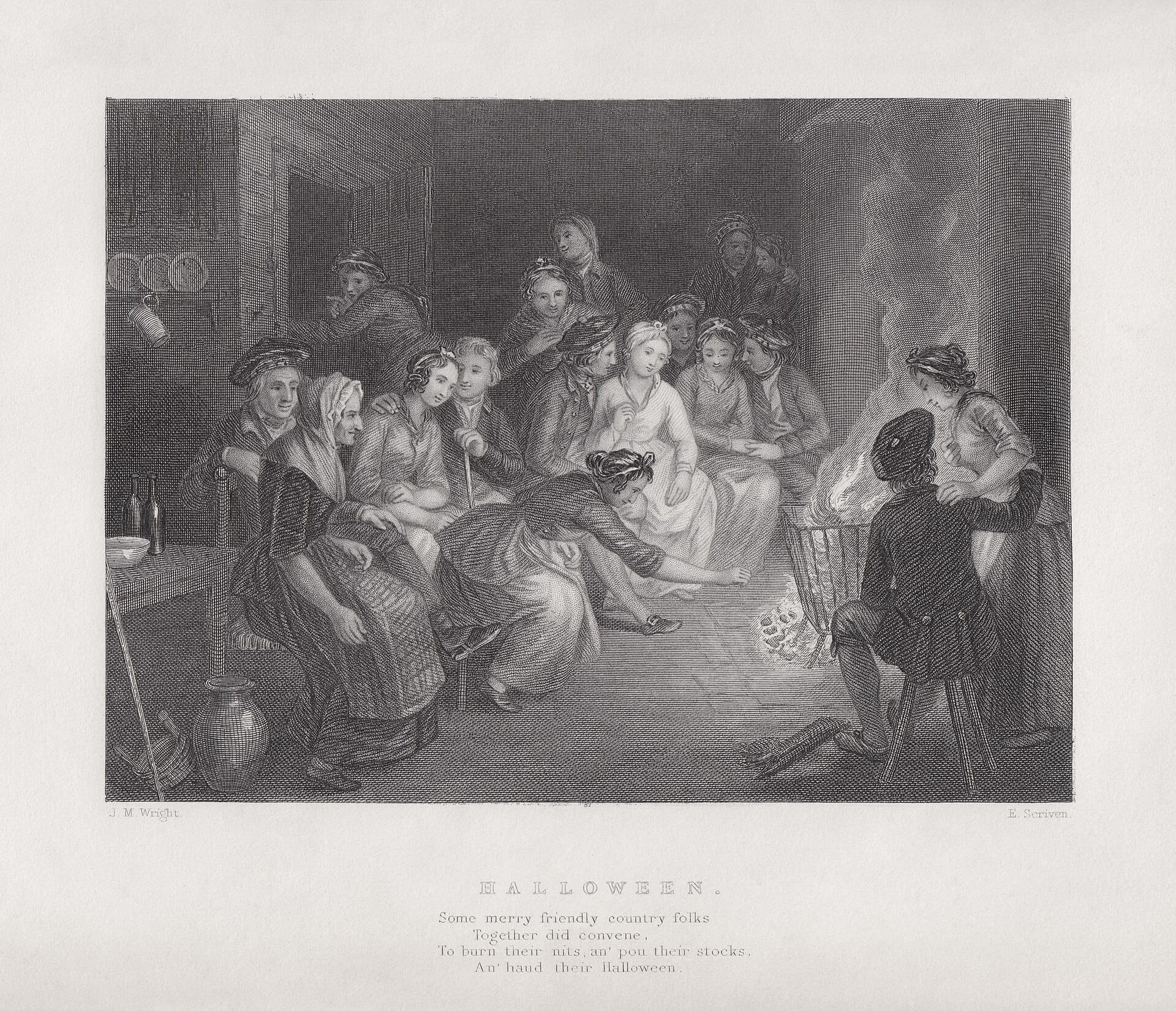
One common festive ritual in Ireland, Scotland and Wales was divination or fortune telling. The main purpose of these fortune-telling rituals was to divine one’s future spouse, but they were also used for more sombre purposes, such as to foretell death. Lisa Morton gives a comprehensive recording of these practices.
Other common practices observed on Halloween involved door-to-door begging usually done by mummers or guisers. Those were ‘figures found at winter festivals in general but particularly appropriate to a night upon which supernatural beings were said to be abroad and could be imitated or warded off by human wanderers.’ Pranks were often played when people imitated evil spirits. Turnips – ‘hollowed out to act like lanterns and often carved with grotesque faces to represent spirits or goblins’ – were held by pranksters for illumination purposes. They were known as ‘spunkies’ or ‘punkies’ or what we now call jack-o’-lanterns.
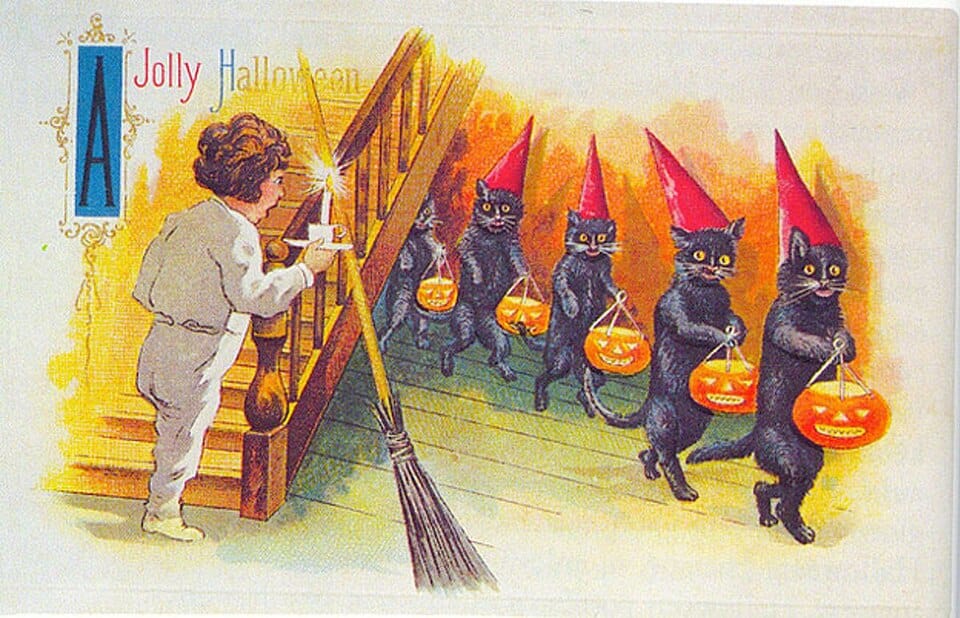
Before the 1900s, however, Halloween was very much ‘muted’ in England. The game changed when the massive-scale Irish immigration to the USA during the 19th century brought an observation of the festival in the ‘new world’. Hutton reports that ‘by the middle of the twentieth century Halloween was established as a major festival in areas of England where Irish influence was strong [...] and during the later twentieth century it increased in popularity throughout England, very much on the American model’. But the revival of Halloween in America is a whole other chapter worthy of attention.
Tracing the origins of Halloween proved to be much more complicated than I had initially expected. Its purpose is neither easy to explain nor straightforward to trace. ‘A patchwork holiday’, declares the National Geographic on clip for the history of Halloween; a rare fusion of the Christian and the pagan, I shall add. A quote from Ronald Hutton’s chapter on Halloween seems to be ideal closing words:
Hallowe’en has many faces and means many things. Rooted in a Celtic Pagan past, it preserves the age-old custom of an end-of-summer feast. It should not be feared, but welcomed as a time to help children and adults come to terms with their fears of change and death. It should also be a time for celebrations, stories and games; a time for laughing in the face of adversity and for challenging the darkness of winter. That seems, at least, to be an argument worth making.
Happy Halloween!

Further Reading
Hutton, Ronald. The Stations of the Sun: A History of the Ritual Year in Britain. Oxford University Press, 1996.
Morton, Lisa. Trick or Treat: A History of Halloween. Reaktion Books, 2012.